
Our story in six cartoons
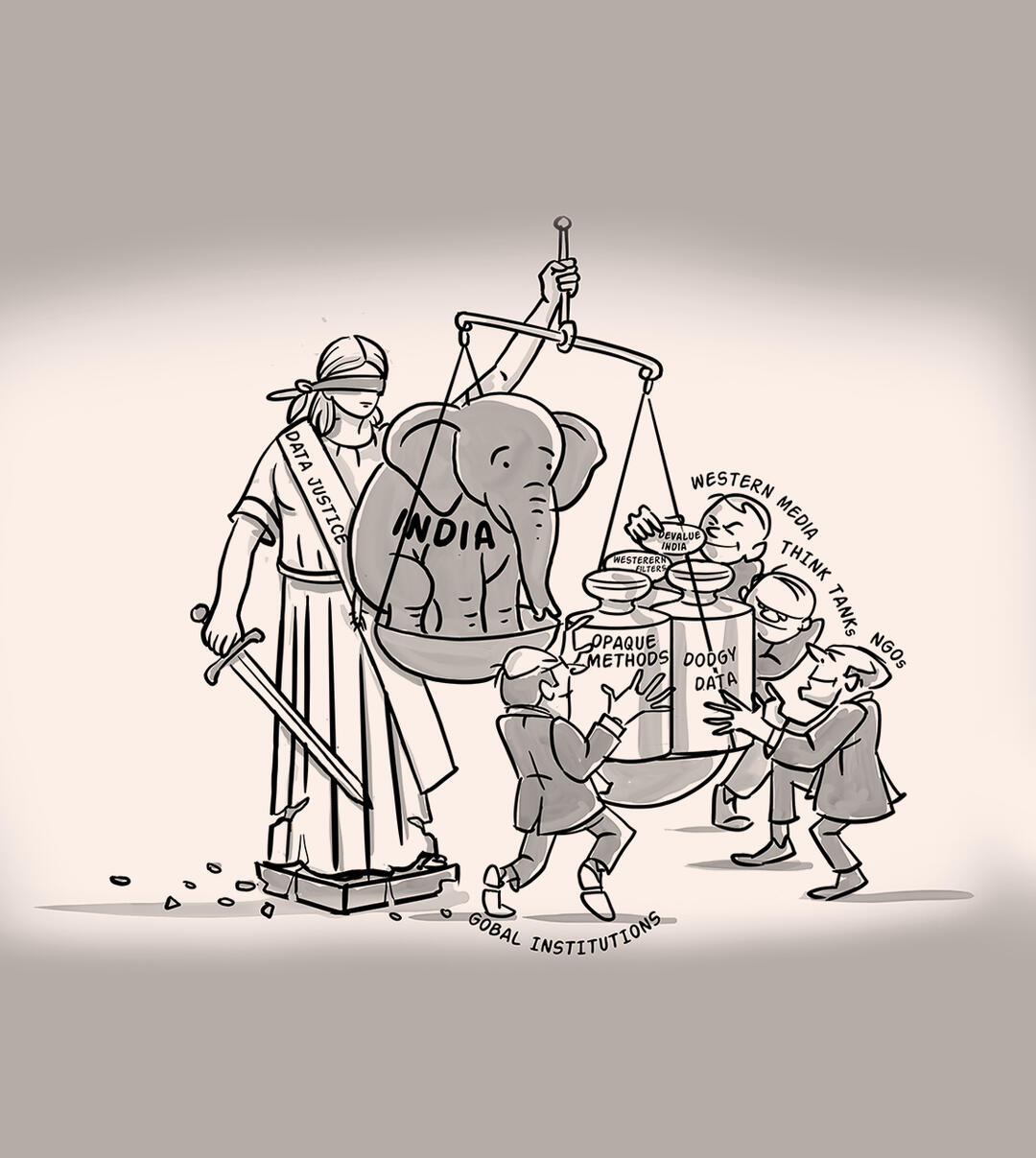
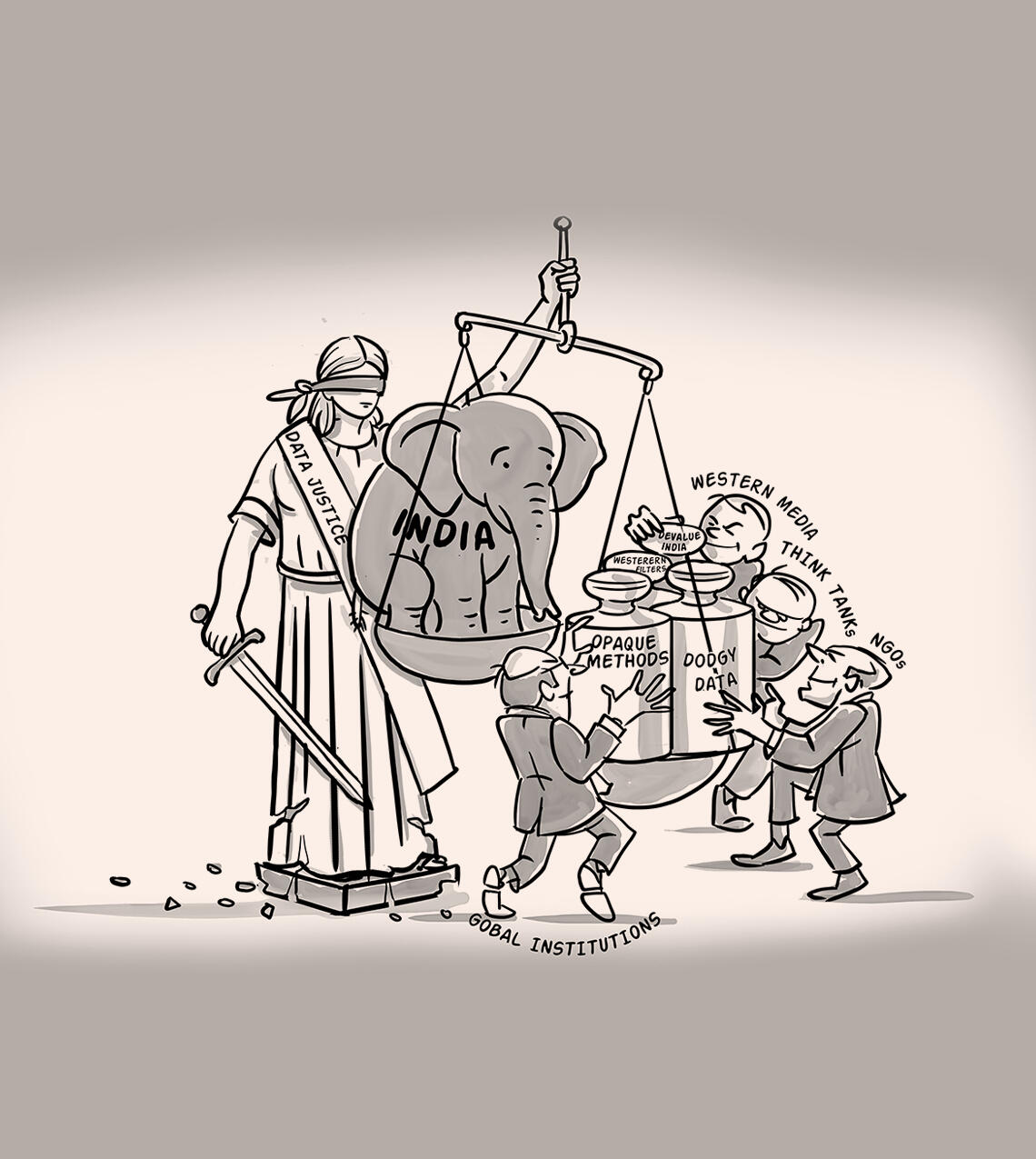
The Scales are Rigged
Exposing how "opaque methods" and dodgy data tip the global scales against India.
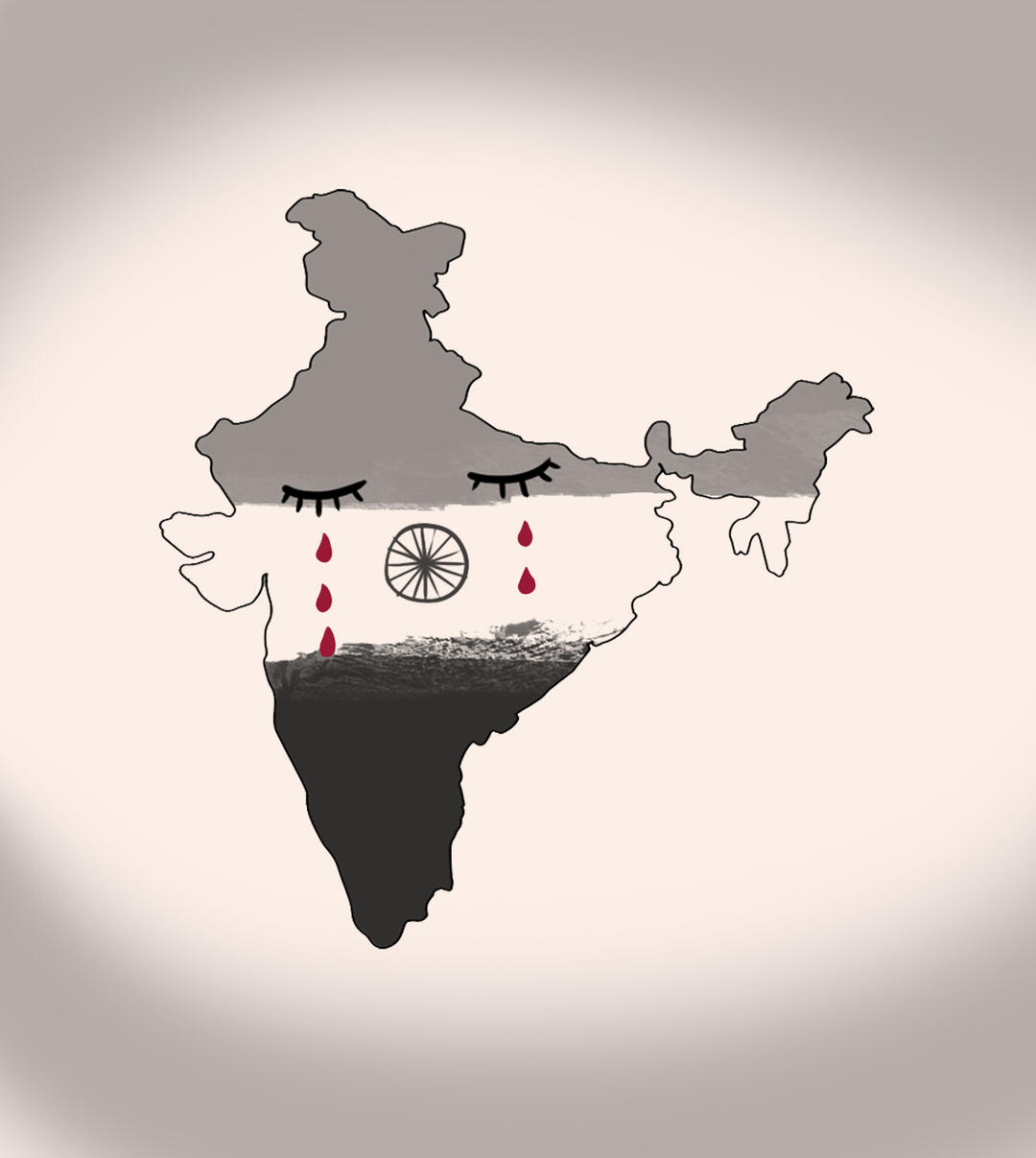
The Penalty Box
How flawed global rankings bleed India of billions annually.
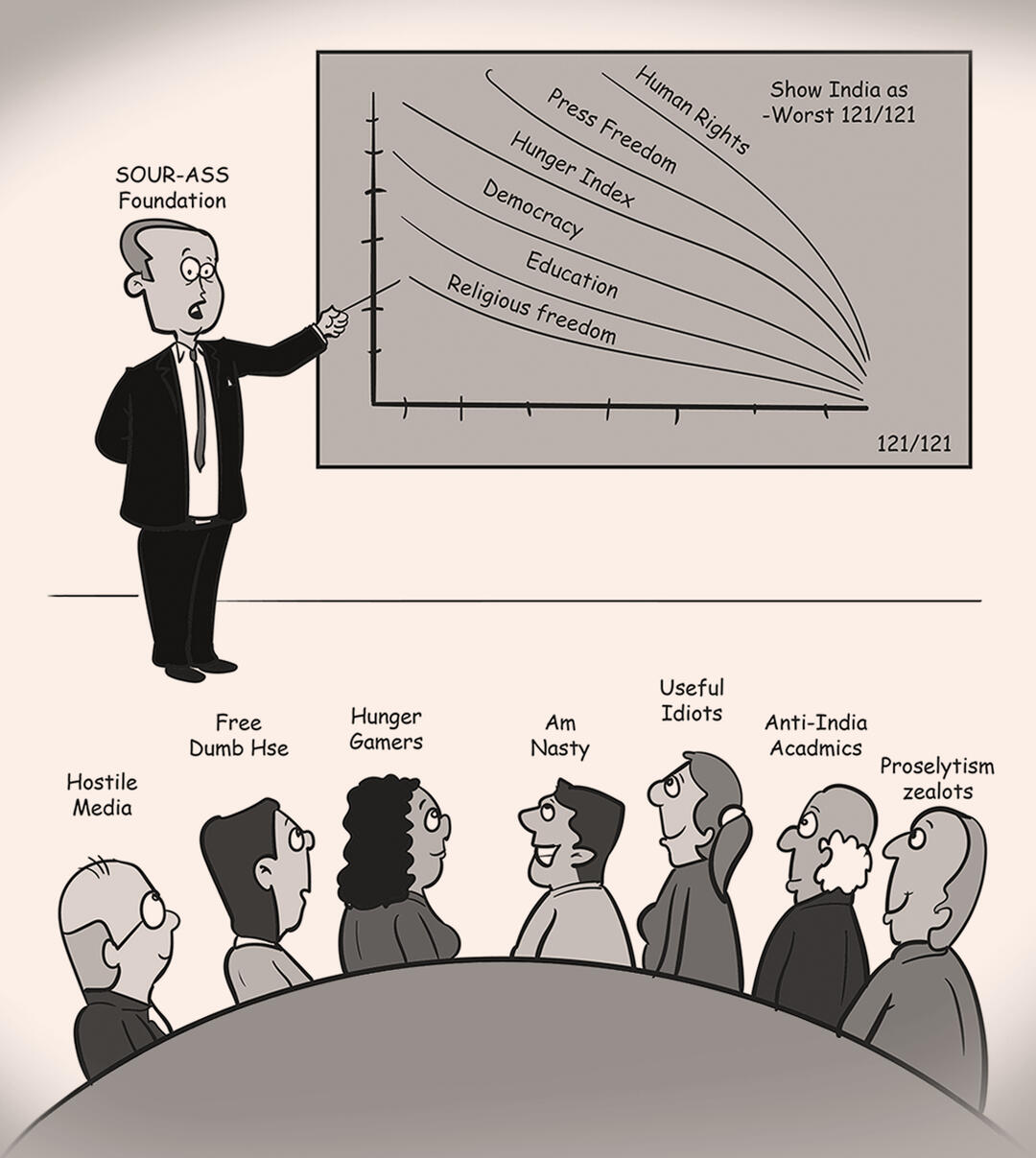
Engineered Narrative
How these global rankings are manufactured to serve agendas, not nations.
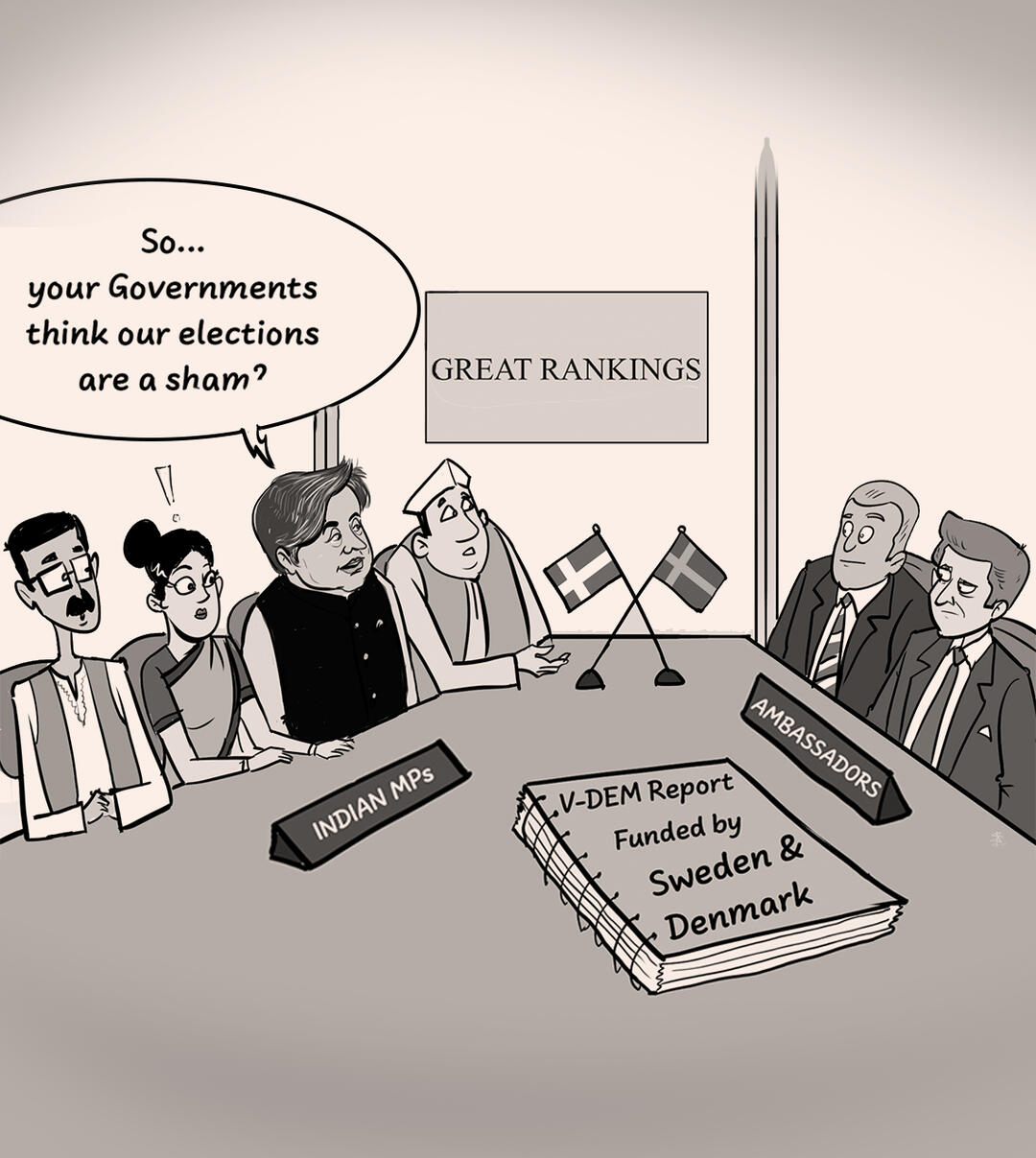
Fighting Back with Facts
How we’re helping India stand up to rigged rankings.
The Truth Dividend
How we are replacing 'opinion polls' with 600,000 facts to reclaim India's story.
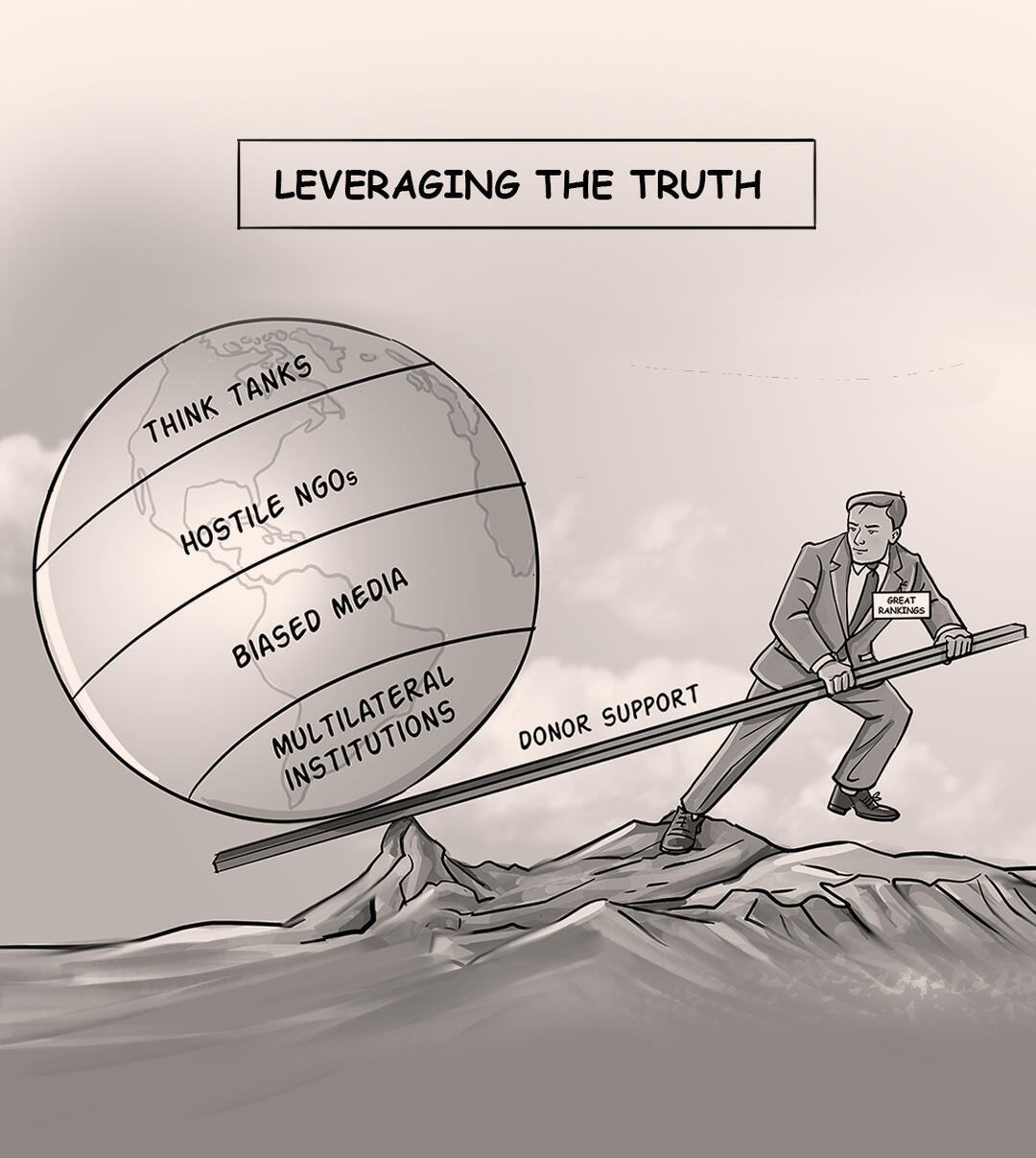
Target 2026
Your support is the force we need to break the monopoly of flawed global rankings

Ramesh Kumar
The Architect of DataSwaraj™
WHEN RIGGED RANKINGS BECOME GLOBAL VERDICTS
Today, more than 80 global indices—covering democracy, media, hunger, environment, and development—shape how India is viewed by investors, governments, multilaterals, and editorial boards. Increasingly, these scores are treated not as indicators, but as final verdicts.
The problem is not measurement. It is how measurement is done, and whose assumptions are embedded in the numbers.
When Ground Reality Meets Opaque Methods
The cartoon’s central metaphor is deliberate: a vast Indian elephant—complex, dynamic, and evolving—outweighed by small jars labelled “Dodgy Data” and “Opaque Methods.” What appears symbolic is, in fact, statistical.
Across multiple global indices, the outcomes follow a familiar pattern—results that increasingly strain credibility.
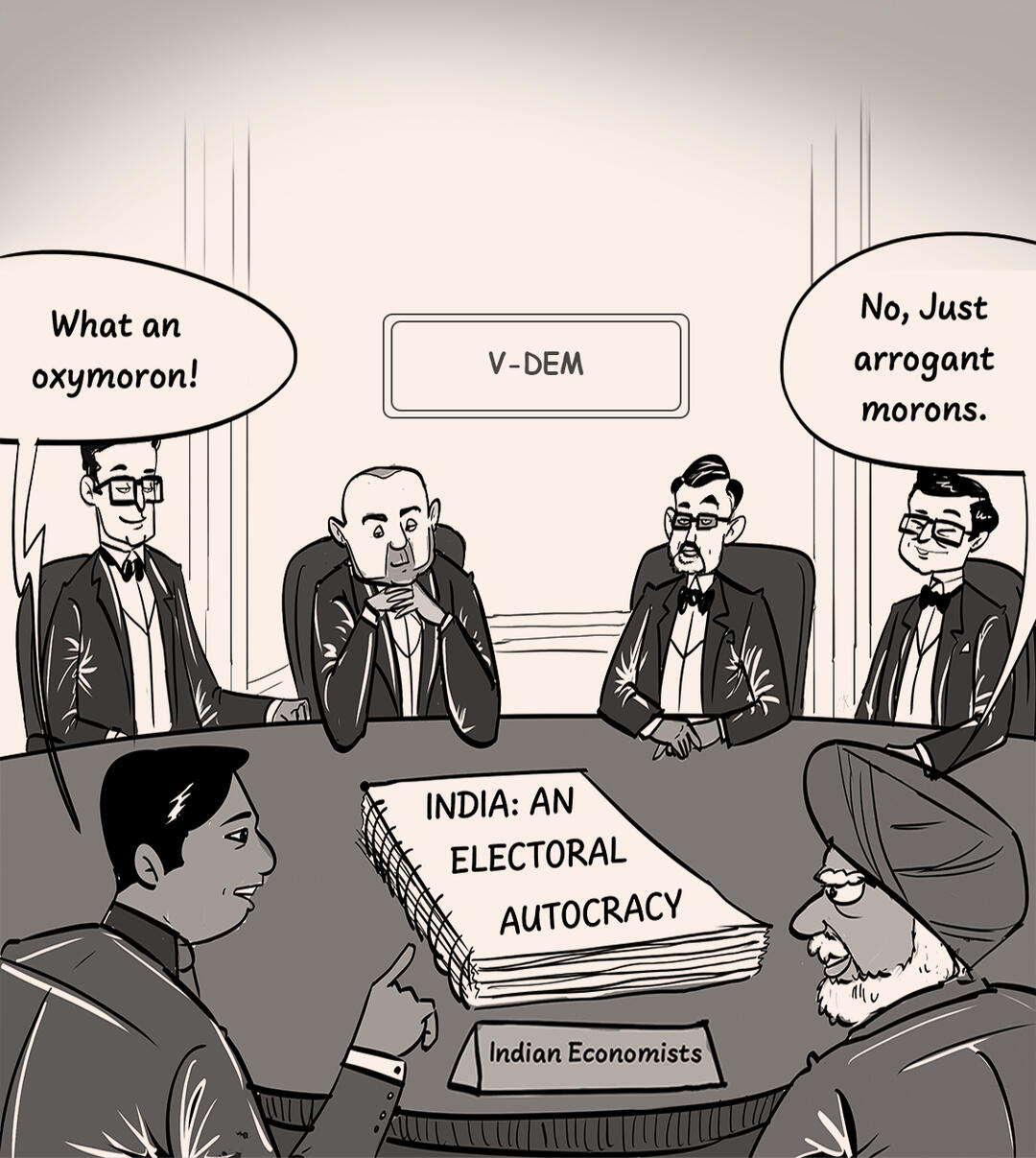
Electoral Democracy (V-Dem)
India ranked 108th, below Tunisia and Colombia—labelled a “backsliding democracy.”
“Democracy cannot be judged by checkbox frameworks.”
— Dr. S. Jaishankar, External Affairs Minister of India
“A case of rickety rankings.”
— PubMed Central, U.S. National Library of Medicine
Environmental Performance Index (Yale–Columbia)
India is ranked 176th out of 180 countries, in the bottom five globally, trailing nations like Sudan and Yemen. This is often used to frame India as a climate laggard in global negotiations.
World Press Freedom Index (RSF)
India ranked 161st, near Bangladesh and below countries such as Nigeria—frequently cited as proof of democratic decline.
“Ignore the noisiest, most diverse media on earth, and you end up measuring only your own echo chamber.”
— NITI Aayog
“The halo of credibility hides flawed, outdated models.”
— Brookings Institution
Human Development Index (UNDP)
India ranked 130th, behind Cuba and Venezuela—used to devalue our growth story.
Global Hunger Index(GHI)
India ranked 102nd, alongside famine hit Sudan and Angola; painted as “starving” despite being one of the world’s largest food producers.
“Exaggerated, double-counted, statistically weak.”
— National Academy of Agricultural Sciences (NAAS), India
A Pattern, Not an Anomaly
Different indices. Similar outcomes. Recycled assumptions. This is not an argument against rankings. It is an argument for rigorous scrutiny.
“India has been ranked below Fiji or Syria on certain indices. These rankings are prejudiced, compromised, and intellectually frivolous.”
— Dr. Deepak Mishra, Director & CEO, ICRIER
Why GREAT RANKINGS?
As Nick Couldry (LSE) and Ulises Mejias caution, resisting data colonialism demands a Non-Aligned Tech Movement.
GREAT RANKINGS was founded to establish DataSwaraj™—data equity through data sovereignty. DataSwaraj™ is India’s answer — a platform to audit, expose, and replace broken global indices with transparent, structural, auditable alternatives for the Global South. Our work empowers policymakers, investors, and institutions with facts, not fiction. GREAT RANKINGS applies that principle to the global ranking economy.
The Invisible Cost of Biased Ranking
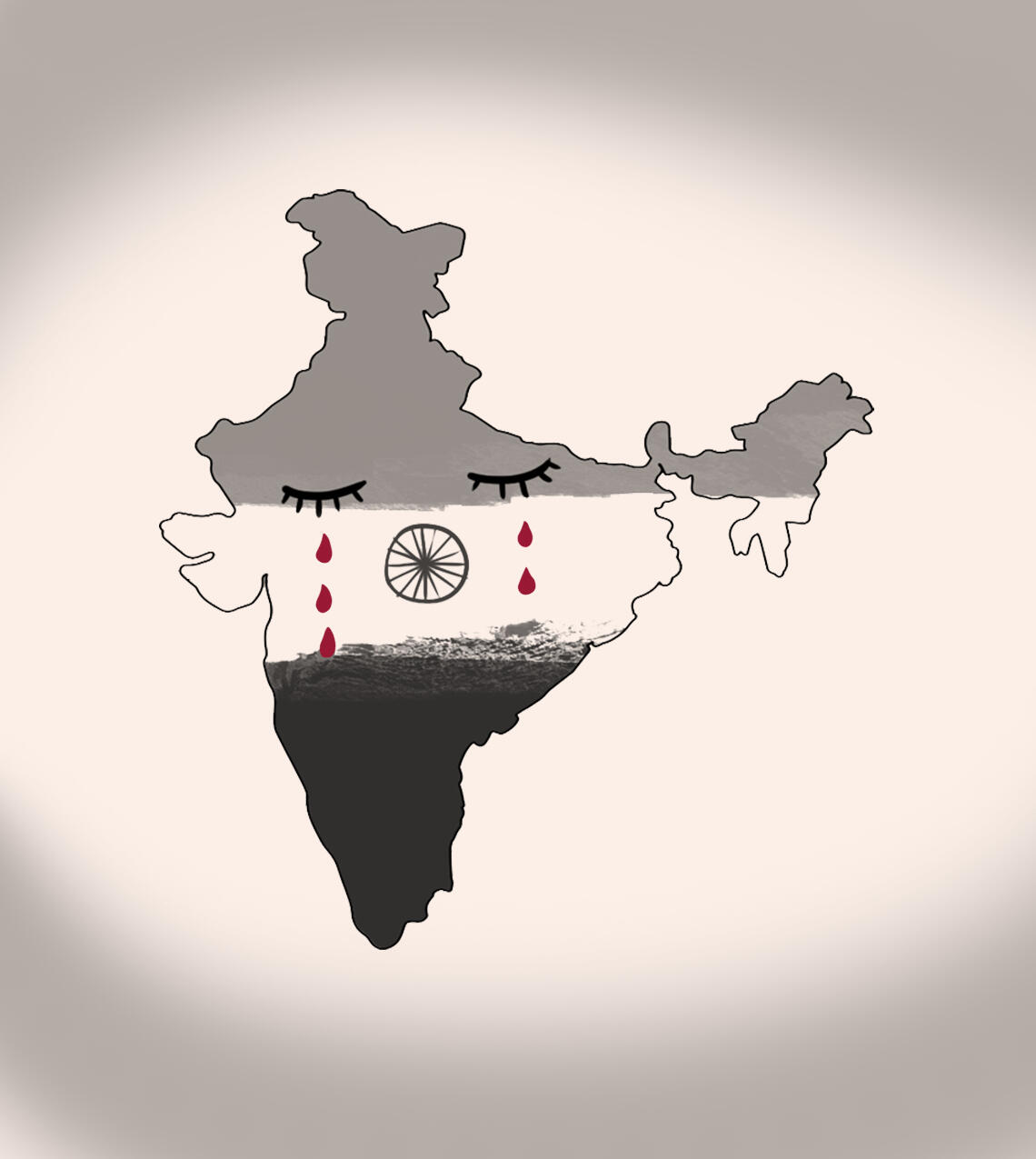
The $19 Billion Perception Gap: India’s Invisible Tax
India is paying a silent, unlegislated tax on its own success. Despite a projected $4.13 trillion GDP for 2025 and a war chest of $700 billion in foreign reserves, the nation remains shackled by bottom-tier "Investment Grade" ratings from global agencies. This isn’t a matter of performance—it’s a crisis of perception. While the markets move on data, global indices are moving on outdated narratives. Every skewed score doesn't just dent a brand; it costs billions in capital that should be building India’s future.
The Bottom Line:
• The Cost: Between $13.5 billion and $19 billion is drained from the economy every year.
• The Weight: This "risk premium" effectively shaves up to 0.45% off India’s GDP.
• The Reality: India maintains a zero-default history and robust macroeconomic fundamentals, yet its credit score fails to reflect its fiscal strength.
Lost Investment Perception
*Estimated loss: $5–8B/year
Indices relying on stale infrastructure data — WEF in 2023 was still citing 2018 numbers — flag India as “medium risk.” This, despite UPI, ONDC, and Gati Shakti.
“When indexes are gamed, capital flows follow fiction — not fundamentals.”
— Synthesis from CGDev & Cambridge studies
“India is arguably the only trillion-dollar economy penalized for being fiscally disciplined.”
— Financial Times, Nov 2023
Borrowing Premiums
*Estimated loss: $2.5–3B+/year
India sits at Baa3/BBB, paying 0.25–0.5% higher spreads than warranted, despite $700+ billion in forex reserves and zero sovereign defaults in history.
Applied to large external debt, the penalties add up fast.
Even blue chip Tata Steel pays more for bonds.
ESG Under-Indexing Costs
*Estimated loss: capital under-flows in the $40T+ ESG universe
ESG assets now exceed $40 trillion, but India’s weight in benchmarks like MSCI Asia ex-Japan remains low.
Western-centric ESG frameworks down-weight India on democracy and media scores while ignoring regional diversity, digital public goods, and scale effects. Funds respond by cutting Funds adjust allocations downward.
“Our ESG weight in Asia ex-Japan was adjusted downward due to India’s aggregate performance metrics.”
— Global ESG fund manager, CLSA, 2023
“Investors rely on indices as heuristic tools… If India scores low, even unjustly, capital looks elsewhere.”
— Brookings, 2023
Trade & Export Losses
*Estimated loss: $6–8B annually
India ranks 38/139 on the World Bank’s Logistics Performance Index. Perceived inefficiencies still cost $6–8 billion annually in lost exports, especially in electronics, pharma, textiles. Studies show a 1.5% trade volume drop for every point lost in logistics scores.
Health Benchmarks & Missed Funding
*Estimated loss: $20–22M in grants; broader losses higher
Despite Ayushman Bharat, India’s lower Universal Health Coverage rankings have reduced participation in select WHO/World Bank funding partnerships, diverting grants toward higher-ranked peers like Kenya and Vietnam. (2024-25). Donor programs too often bypass India in favor of higher-ranked nations.
“The methods underpinning country indices are, at best, contestable and non-transparent, and at worst, dubious.”
— Global Policy Journal
* These are Estimated / Plausible metrics given available data, but not exact amounts fully backed by public datasets.
The GREAT RANKINGS SOLUTION
GREAT RANKINGS is building the first evidence-led, open-methodology global ranking platform designed to challenge bias firmly, factually, and transparently.
Not with counter-narratives—but with verifiable data, auditable methods, and indices the world can test, not just cite.
This is how the bleeding stops.
When Opinion Is Laundered Into “Global Fact”
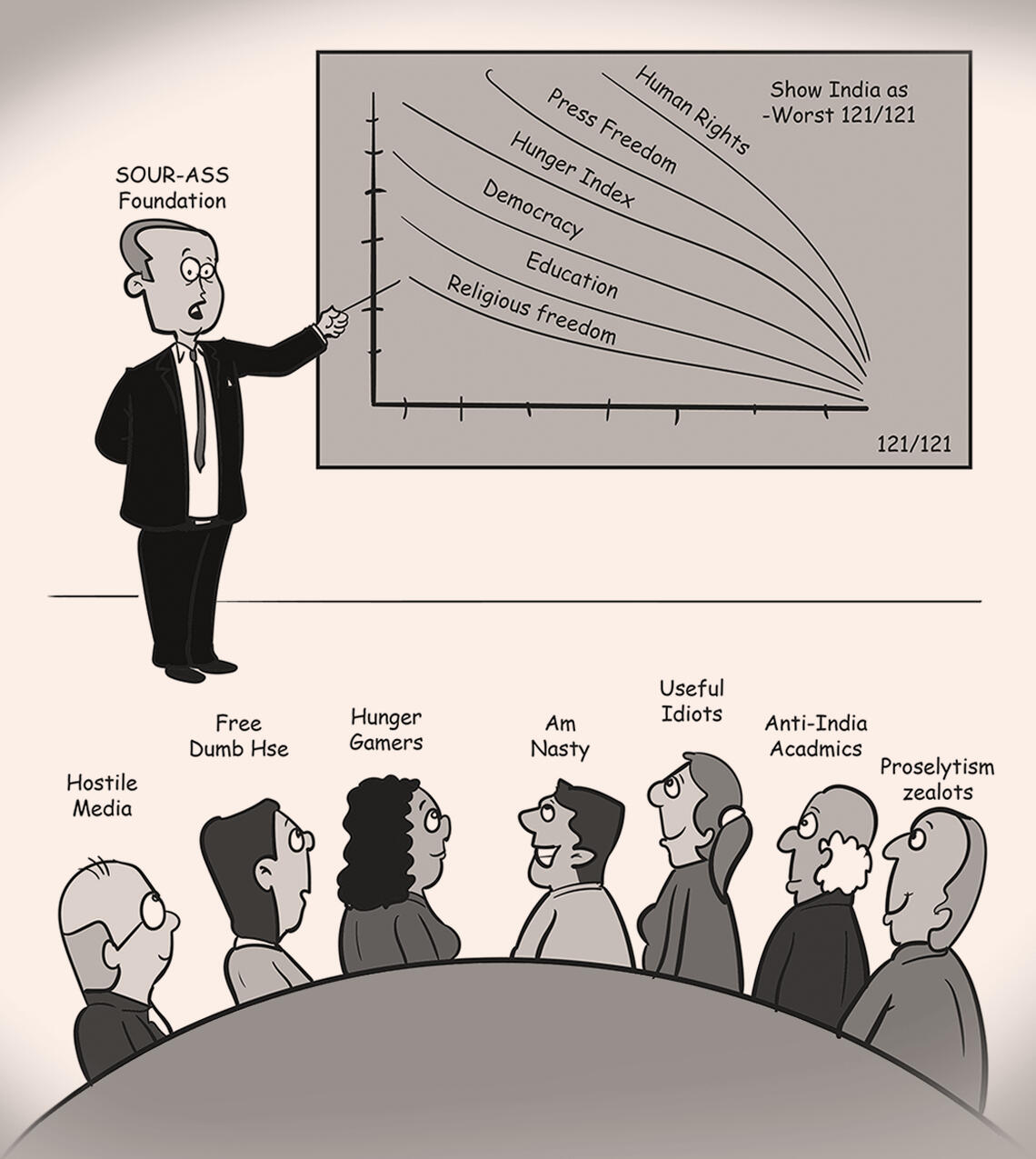
The cartoon beside this text, The Ranking Toolkit, captures a system operating in plain sight.
What present themselves as neutral global rankings are, in practice, engineered outcomes: produced within a closed ecosystem where opinion circulates until it acquires the authority of fact.
This is no longer conjecture. It is now on record.
Economist Sanjeev Sanyal, member of the Prime Minister’s Economic Advisory Council, has described the global rankings industry as a “narrative laundering mechanism” that engineers political and ideological opinion into certified truth.A small group funds the studies, authors the reports, and then cites the same indices as independent validation—a closed narrative loop.
A Pattern, Not an Anomaly
The outcome is strikingly consistent.
The result is a recurring anomaly: India performs “conspicuously poorly across indices”, regardless of domain, time period, or ground reality—an outcome rooted not in data, but in a North Atlantic consensus loop.
A closed funding circuit
Influential indices are financed by a narrow network of billionaire-backed foundations and Western public institutions, including George Soros’s Open Society Foundation, Rockefeller Foundation, Ford Foundation, US agencies and the European Union—concentrating agenda-setting power.
A tiny “expert” echo chamber
Country rankings are often driven by the views of five to thirty unnamed ‘experts’—a sample size that would fail even a student election survey. This is obvious garbage.
Institutional validation without scrutiny
This "obvious garbage" is then certified by bodies like the World Bank. Once published, these scores are amplified by multilaterals, media, and markets—often without independent audit—hardening perception into policy.
Sanyal’s conclusion is blunt: a “circular Ponzi scheme”, where recycled opinion masquerades as objective measurement.
When the Toolkit Fails: A Record on File
World Bank’s Ease of Doing Business: Exposed
Scrapped in 2021 after an independent investigation exposed fraudulent data manipulation by senior officials to favour China’s ranking.
Corruption Perceptions Index (CPI) : Discredited
Its original architect, Johann Graf La mbsdorff, disengaged in 2009 over methodological disputes. Alex Cobham (Tax Justice Network) later stated the index “corrupts perceptions to the extent that it’s hard to see a justification for its continuing publication,” arguing it reflects the bias of Western observers rather than objective reality
ESG Indices: : Branded a “SCAM”.
Elon Musk famously declared: "ESG is a scam. It has been weaponized by phony social justice warriors," highlighting how political agendas and ideological scoring can override objective performance metrics.
Global Hunger Index: Flawed by Design
Conflates child stunting and wasting with national hunger; relies on small-sample perception surveys unsuited to India’s scale. The ICMR and the Government of India have formally rejected it as statistically weak and misleading, noting its failure to account for the National Food Security Act.
S&P Global Ratings: Questionable integrity
Paid $77 million in penalty to SEC 2015 for manipulating CMBS rating models to retain issuer business; penalised again in 2022 for allowing commercial pressure to override analytical integrity.
University Rankings: Lacking Credibility
John P.A. Ioannidis of Stanford warned their methods are “too poor to carry serious scientific credibility,” with implications for global education policy.
The Implication
These are not isolated lapses.
They reveal a structural weakness in how rankings are structured, validated, and monetised.
When opinion is repeatedly certified as fact, the cost is not reputational alone.
It is economic, institutional, and systemic.
DataSwaraj™
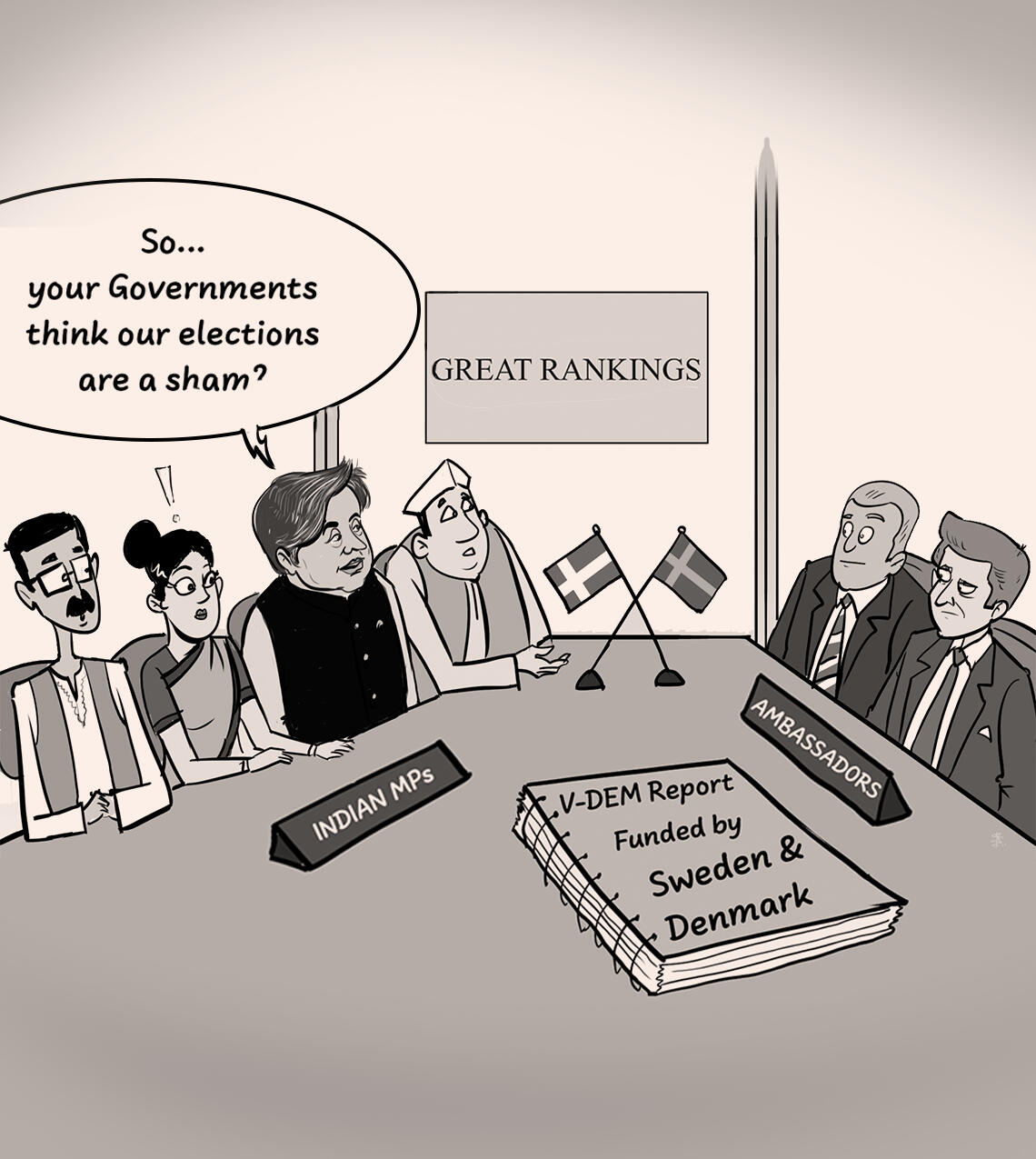
GREAT RANKINGS equips policymakers with the evidence to challenge unfair labels — ensuring the global conversation reflects India’s reality, not ideological scoring.
GREAT RANKINGS was founded to establish DataSwaraj™—data equity through data sovereignty. We audit and challenge powerful global indices, and where they fail, replace them with open, auditable, evidence-driven rankings the world can verify, not merely accept. This is a structural push for data dignity, narrative sovereignty, and economic fairness—for India and the Global South.As Nick Couldry (LSE) and Ulises Mejias caution, resisting data colonialism demands a Non-Aligned Tech Movement. GREAT RANKINGS applies that principle to the global ranking economy.
If we do not measure ourselves, others will mismeasure us. Let’s act before misperception becomes policy
2025
Forensic review of the 20 most consequential global indices — published openly across X, LinkedIn, and Medium.
Accomplished!
2026
Launch the DataSwaraj™ India Index series, beginning with
DataSwaraj™ India Hunger Index
2027
DataSwaraj™ India Media Index 2027
DataSwaraj™ India Democracy Index
Why Start with the Hunger Index?
The current Gold Standard “Global Hunger Index (GHI) devised and published by two NGOs in Ireland and Germany, is perhaps the most consequential—and least defensible—of the global rankings shaping India’s narrative. It operates in a vacuum: India has no exact counter-index, its claims drive headlines despite methodological flaws, and its conclusions are repeatedly amplified without technical scrutiny.DataSwaraj™ India Hunger Index is therefore the logical first intervention—fast and high-impact—designed to correct the record where distortion is greatest and evidence is simplest to verify.
This is how we shift the global narrative — with data, not outrage.
cHECK OUT OUR REVIEW OF GLOBAL INDICES
The DataSwaraj™ Manifesto: A New Standard for Global South Data
From Perception-Based Metrics to Data Sovereignty
For decades, the story of India and the Global South has been told through indices designed in the West, for the West. These metrics often rely on subjective "expert opinions" and narrow cultural lenses that fail to capture the structural realities of a billion-plus people.
At GREAT RANKINGS, we do not just provide "better" numbers; we provide the correct framework.
The Four Pillars of DataSwaraj™ Methodology
1. Hard Data Over Soft Perception
Traditional indices often rely on "perception surveys" from a small circle of "experts." We reject this subjectivity.
The DataSwaraj™ Rule: Every data point must be rooted in verifiable, quantitative evidence—satellite imagery, official household records, and transaction-level data—rather than the opinions of a few.
2. Contextual Sovereignty
A yardstick used to measure a small, homogeneous European nation cannot be used to measure a continental-scale civilization like India.
The DataSwaraj™ Rule: Our indices account for local nuances—geography, dietary diversity, cultural structures, and historical trajectories. We measure progress relative to a nation’s unique challenges, not against an arbitrary Western ideal.
3. Radical Transparency (The "Open-Source" Ethos)
Western indices are often "black boxes" where the final ranking is obscured by secret weighting systems.
The DataSwaraj™ Rule: We publish our full raw data sets, our weightage formulas, and our code. We invite the world to "stress-test" our findings. If the data is correct, it must be able to withstand the light of total transparency.
4. Structural Equity
We look beyond the surface. For hunger, we don’t just look at child mortality; we look at food distribution networks. For democracy, we don’t just look at voting; we look at the structural empowerment of the marginalized.
The DataSwaraj™ Rule: We measure the systems, not just the symptoms.
Our Promise: Data as a Tool of Liberation
Just as the salt of Dandi was a symbol of physical self-rule, the data of DataSwaraj™ is the tool of digital self-rule. We provide India and the Global South with the intellectual weaponry to challenge unfair narratives and the tactical data to build a more just future. We are building these indices in India to prove the methodology. Then, we take them global.
The goal is simple: DataSwaraj™. Global Rankings with Equity And Transparency.
Action Plan 2026-27
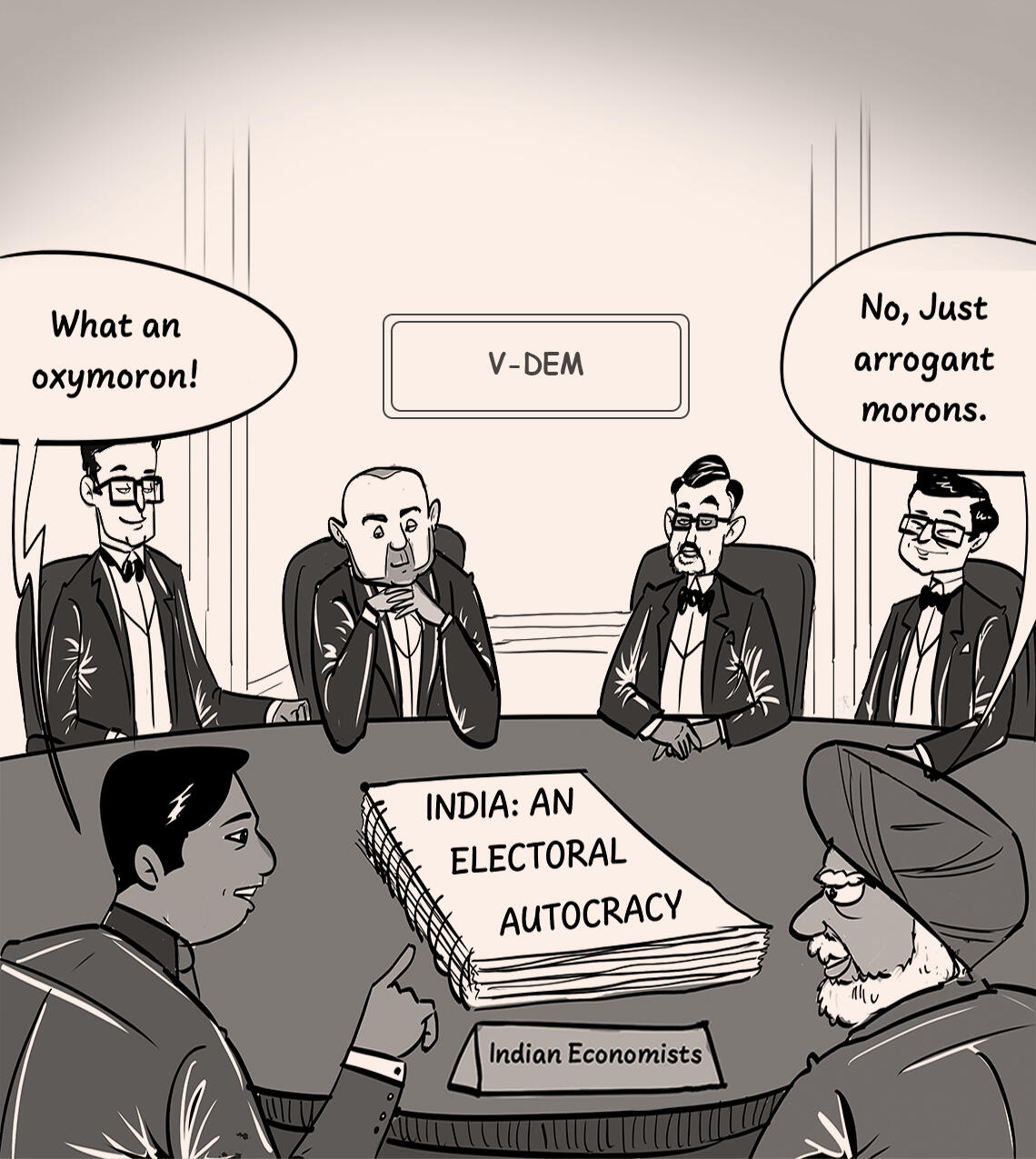
DataSwaraj ™ India Hunger Index 2026 is our first initiative.
The Global Hunger Index (GHI)—published by Irish and German NGOs and widely treated as a gold standard—illustrates how global rankings misrepresent India.
Despite being the world’s 5th-largest economy, with record food stocks and expansive welfare coverage, India is ranked below/alongside conflict-affected countries such as Sudan and peers like Pakistan.
The Global Hunger Index (GHI) is a legacy model built on sparse data and western-centric benchmarks. DataSwaraj™ is India’s definitive response—a rigorous, clinical, and sovereign audit of the nation’s nutritional health.
Comparative Framework: GHI vs. DataSwaraj™ India Hunger Index
Indicator 1: Undernourishment
Global Hunger Index (GHI)
PUN (Proportion of Undernourished): Based on Gallup/FIES opinion surveys (~3,000 people).
DataSwaraj™ India Hunger Index (D-IHI)
HNS (Household Nutritional Security): Integrated data from NSSO/NFHS-6 (600,000+ households) + PMGKAY delivery logs.
Why DataSwaraj™ is More Accurate
Sample Size: 200x larger. It measures actual grain consumption and safety net impact rather than "perceived" food anxiety.
Indicator 2: Stunting
Global Hunger Index (GHI)
Child Stunting: Measures height-for-age against a universal WHO benchmark.
DataSwaraj™ India Hunger Index (D-IHI)
LGC (Linear Growth Contextualization): Stunting adjusted for regional Genetics and Environmental Enteropathy (WASH).
Why DataSwaraj™ is More Accurate
Biological Rigor: Accounts for the "Sarmiento Effect"—recognizing that height is 60–80% genetic and not purely a proxy for hunger.
Indicator 3: Wasting
Global Hunger Index (GHI)
Child Wasting: Relies on lagged, infrequent survey data (NFHS).
DataSwaraj™ India Hunger Index (D-IHI)
RPM (Real-time/Acute Monitoring): Uses Poshan Tracker monthly digital audits (7.2 Crore+ children).
Why DataSwaraj™ is More Accurate
Velocity: GHI uses 2-3 year old data; DataSwaraj™ uses data from the last 30 days, identifying acute crises before they become mortality events.
Indicator 4: Mortality
Global Hunger Index (GHI)
Under-5 Mortality: Weighted at 1/3 of the total score.
DataSwaraj™ India Hunger Index (D-IHI)
N-AM (Nutrition-Attributed Mortality): Isolates mortality caused by caloric gaps vs. lack of medical infrastructure.
Why DataSwaraj™ is More Accurate
Policy Precision: If a child dies of fever without a clinic, GHI calls it "Hunger." DataSwaraj™ identifies it as a Healthcare Access Gap, preventing misallocated funds.
Indicator 5: Hidden Hunger
Global Hunger Index (GHI)
Ignored: Only tracks calories/weight.
DataSwaraj™ India Hunger Index (D-IHI)
Micronutrient Profile: Tracks Anemia and Vitamin A/D/B12 levels (The "Hidden Hunger" of the Global South).
Why DataSwaraj™ is More Accurate
Holistic Health: Many children have enough calories but are malnourished. DataSwaraj™ identifies this "Double Burden" missed by the GHI.
Three Verifiable Methodological Failures in the GHI
1. Child Wasting Distortion:
Child wasting (≈ 18.7%) disproportionately penalizes India. Child indicators account for two-thirds of the GHI score, masking massive progress in food availability, adult nutrition, and the world's largest welfare reach.
2. Weak Undernourishment Estimation (PoU):
One-third of the score relies on FIES surveys of ~3,000 respondents for a population of 1.4 billion. It effectively "erases" the PMGKAY, which supplies free foodgrains to 800 million people at a national scale.
3. Conceptual Conflation:
GHI collapses "Hunger" (caloric deficiency) into "Undernutrition" (a health outcome driven by sanitation, maternal health, and infections). Three of four indicators measure health outcomes, misdirecting policy and obscuring successful programs like the ICDS.
Conclusion: GHI does not measure population-wide hunger accurately. It produces a misleading global signal.
The DataSwaraj™ Advantage: Precision Nutrition
The DataSwaraj™ India Hunger Index 2026 is India’s definitive response. Utilizing a massive, high-fidelity sample of 600,000 households, this index moves beyond "hunger" to map Precision Nutrition. It distinguishes between food-based stunting and WASH-related (Water, Sanitation, Hygiene) health deficits with clinical accuracy
1. Scope & Granularity
• Comprehensive: 7–8 multidimensional indicators (adults, children, diet, sanitation, micronutrients).
• Localized: Covers state and district-level data to empower local administrators.
2. The Data Engine
• High-Fidelity Sources: Powered by NFHS-6, NSSO, CNNS, and real-time Poshan Tracker audits.
• Welfare Integration: Directly captures the impact of NFSA, PMGKAY, and ICDS.
3. Rigorous Method & Validation
• India-Normed: Weights are aligned with ICMR (Indian Council of Medical Research) standards.
• Radical Transparency: 100% open-source datasets and code. No "Black Box" modeling.
• Peer-Reviewed: Guided by PhDs in health economics and public policy, matching the global standing of scholars like Dr. Stephan Klasen and Dr. Lawrence Haddad (IFPRI/GAIN).
The DataSwaraj™ India Hunger Index is not just an index; it is an act of intellectual decolonization. We are replacing statistical malpractice with a high-resolution map of India’s true nutritional landscape.
The DataSwaraj™ India Hunger Index 2026 will be published with full methodological disclosure, data provenance notes, and independent expert review. No proprietary scores. No black-box models.
Fund The Lever
Strategic Partnership Options
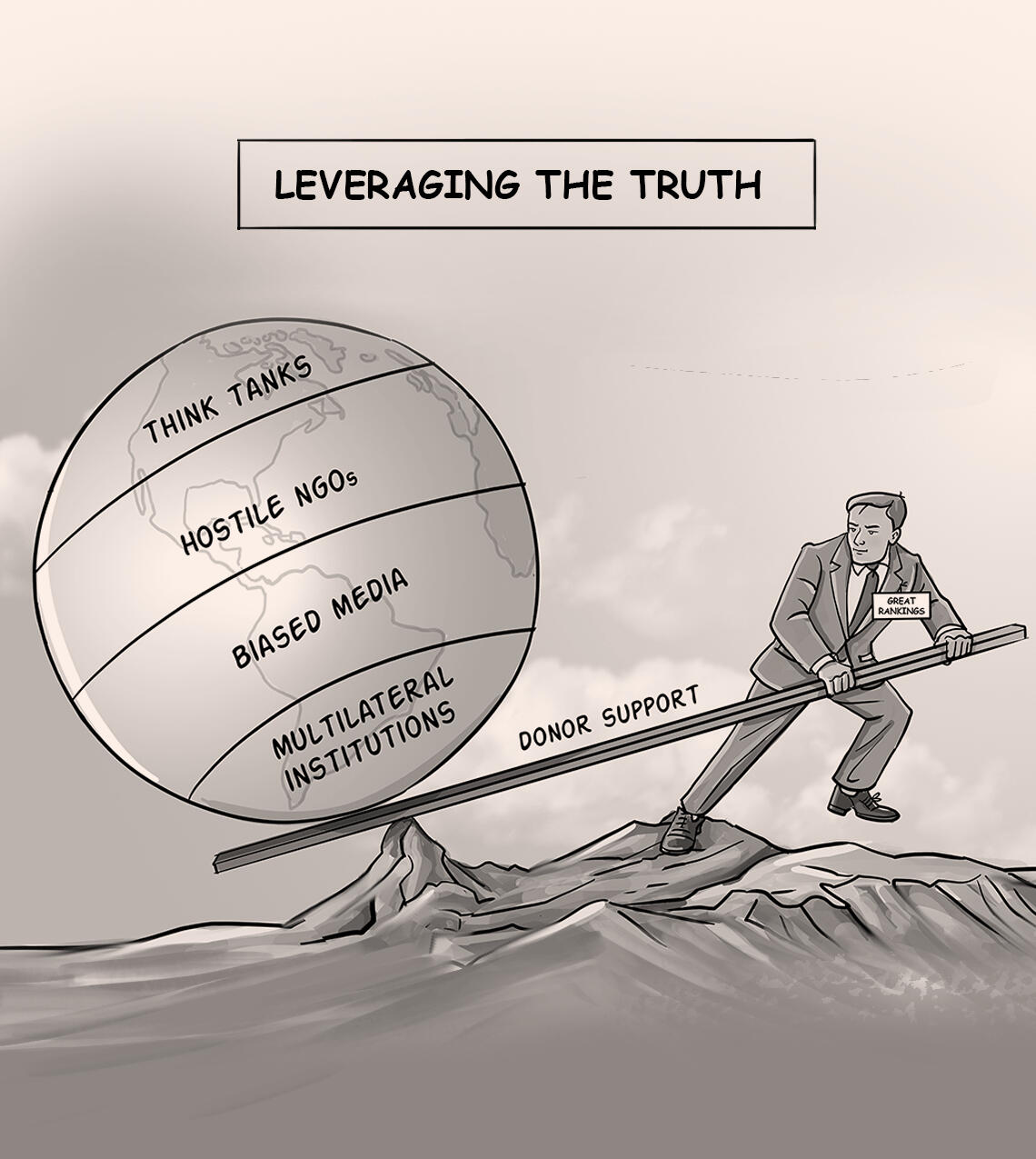
Option 1: Direct Strategic Investment (Institutions & Foundations)
DataSwaraj™ India Hunger Index 2026 marks the shift from analysis to intervention.Your investment funds “The Lever”—the engine required to challenge biased global indices, restore statistical integrity, and reclaim India’s narrative sovereignty.This is targeted capital. Deployed where flawed rankings create real economic consequences.Fund the Lever. Reset the metric.
OPTION 2: FUND THE LEVER (FOR THE VCs)
A 90-Day Window. A National Inflection Point.
You already know this: narratives shape markets. And today, biased global indices are quietly hurting India’s macro story, your portfolio valuations, and LP risk perception.
At GREAT RANKINGS, we’re building India’s counterweight:
transparent, auditable, India led indices — grounded in real data, not recycled ideology.
The cost of inaction:
₹1.1–1.6 lakh crore ($13.5–19B) lost every year through distorted FDI signals, inflated credit spreads, ESG exclusion, and reputational drag.
The cost of action:
A fraction — and it starts now.
IMMEDIATE NEED — NEXT 90 DAYS
Pilot Study Begins
We are initiating the pilot for the DataSwaraj™ India Hunger Index. This requires onboarding a doctoral-level health economist and a statistician with expertise in:
• NFHS (National Family Health Survey)
• NSSO health / consumption rounds
• WHO & UNICEF nutrition datasets
• Data cleaning, normalisation, indicator constructionThis foundational work must begin now, before global indices publish their next cycle. Your bulk order directly funds this research.

The ask: Bulk-Order 'Never Waste a NO'
• ₹500 per copy
• Minimum 200 copies
• Co-branding available
• Acknowledge your fund in our supporter’s circle.
Dual ROI for Your Fund
Portfolio ROI — Founder Resilience
Never Waste a NO is a fast paced cartoon survival guide for founders — sharp, funny, behaviour-changing. It reframes every NO as free market research on the path to YES. This is the kind of book founders actually finish.Ideal for:
• Founder Welcome Kits
• Portfolio Offsites & Townhalls
• Pre-Seed/Seed Outreach
• Event Giveaways
• Founder Libraries
• Demo Day GiftingSupport your founders with a tool they will actually use
Ecosystem ROI — Macro Narrative Defense
Your bulk order directly funds DataSwaraj™ India Hunger Index — India’s alternative to black-box indices like GHI.What this unlocks:
• Open, auditable hunger scorecard.
• Proof-based validation of welfare programs (PMGKAY)
• Transparent methodologies anyone can inspect
• A credible counter-narrative at global forums
• Better India macro → stronger founder confidence → better valuations → better exits.This is ecosystem stewardship.
A meaningful founder gift — and the lever that funds India’s first transparent, sovereign index infrastructure.Be the fund that backed this early. Not with another cheque, but using “a perspective with a smile”.
Never Waste a No” is one in the “Dear Founder” series published by Cartoon Blogger book publishing. Cartoon Blogger was inspired by the following quote:
"Warren helped Melinda and me do two things that are impossible to overdo in one lifetime: learn more and laugh more."
— BILL GATES
Get in Touch
About the Founder
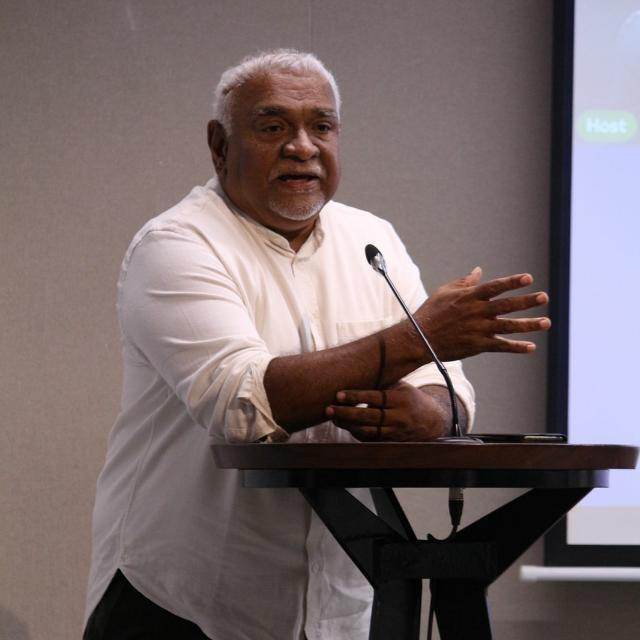
Ramesh Kumar
The Architect of DataSwaraj™
The driving force behind GREAT RANKINGS is Ramesh Kumar:
• Post Graduate in Entrepreneurial Management
• 25 years corporate veteran
• Cartoonist & Author
• Startup Satirist
• Editor & PublisherHis mission is built on decisive experience, leveraging a career in corporate leadership and publishing to forge the blueprint for data reform.

Cartoon Blogger Book Publishing helped the founders re-think their strategy and tactics and laugh all the way to the bank.
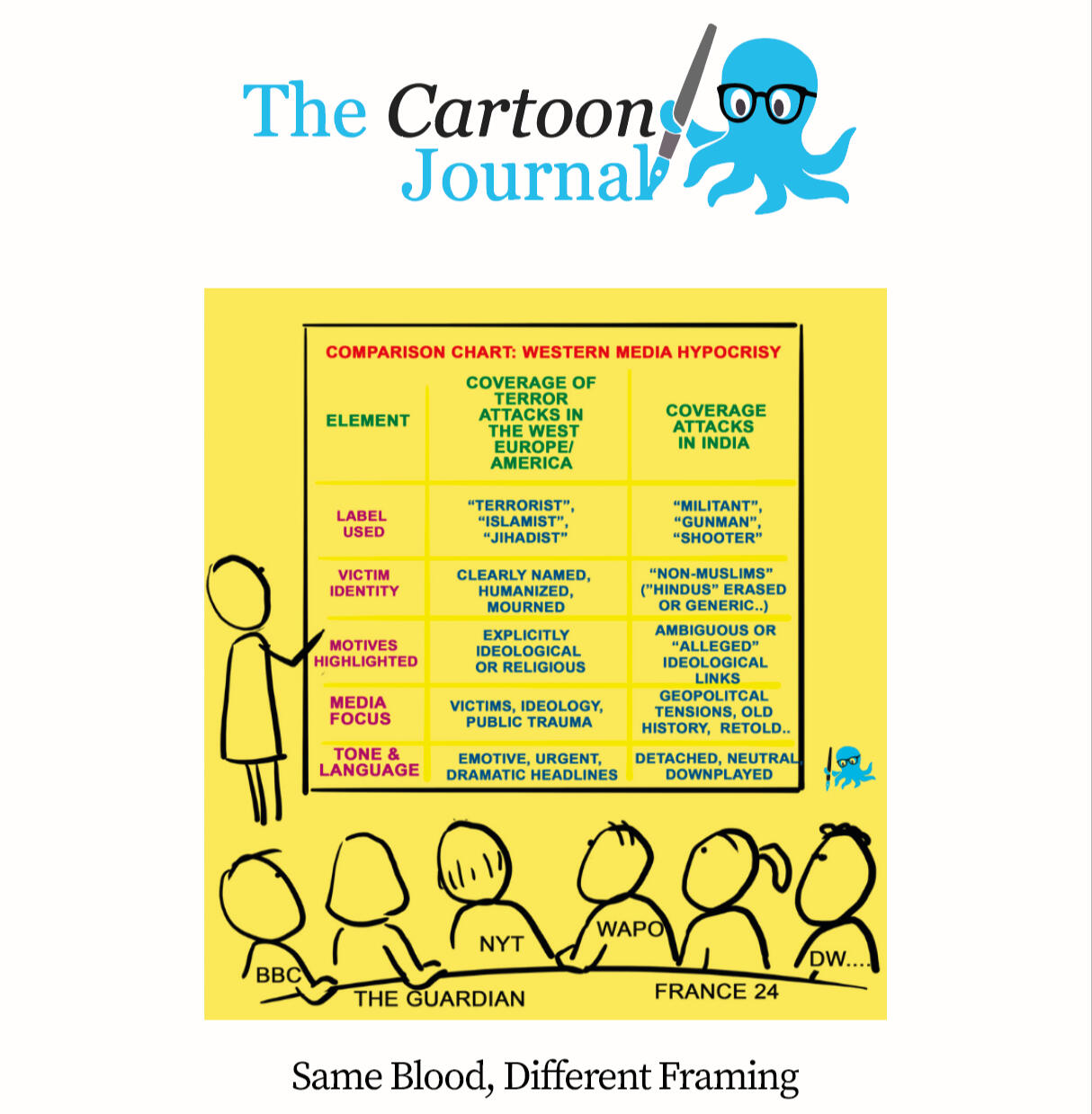
The Cartoon Journal was a bold experiment in nationalist satire exposing Western hypocrisy.
These formative ventures were masterclasses in strategic disruption, transforming challenges into a powerful foundation for global impact. Today, that same analytical mind, resilience, and flair for satire exposes the flaws in global indices. And his entrepreneurial daring has propelled him to launch his fight for data justice.Under his leadership, GREAT RANKINGS will soon research and publish the India-led GREAT RANKING series, directly taking on the legacy vested giants in the index ecosystem.